


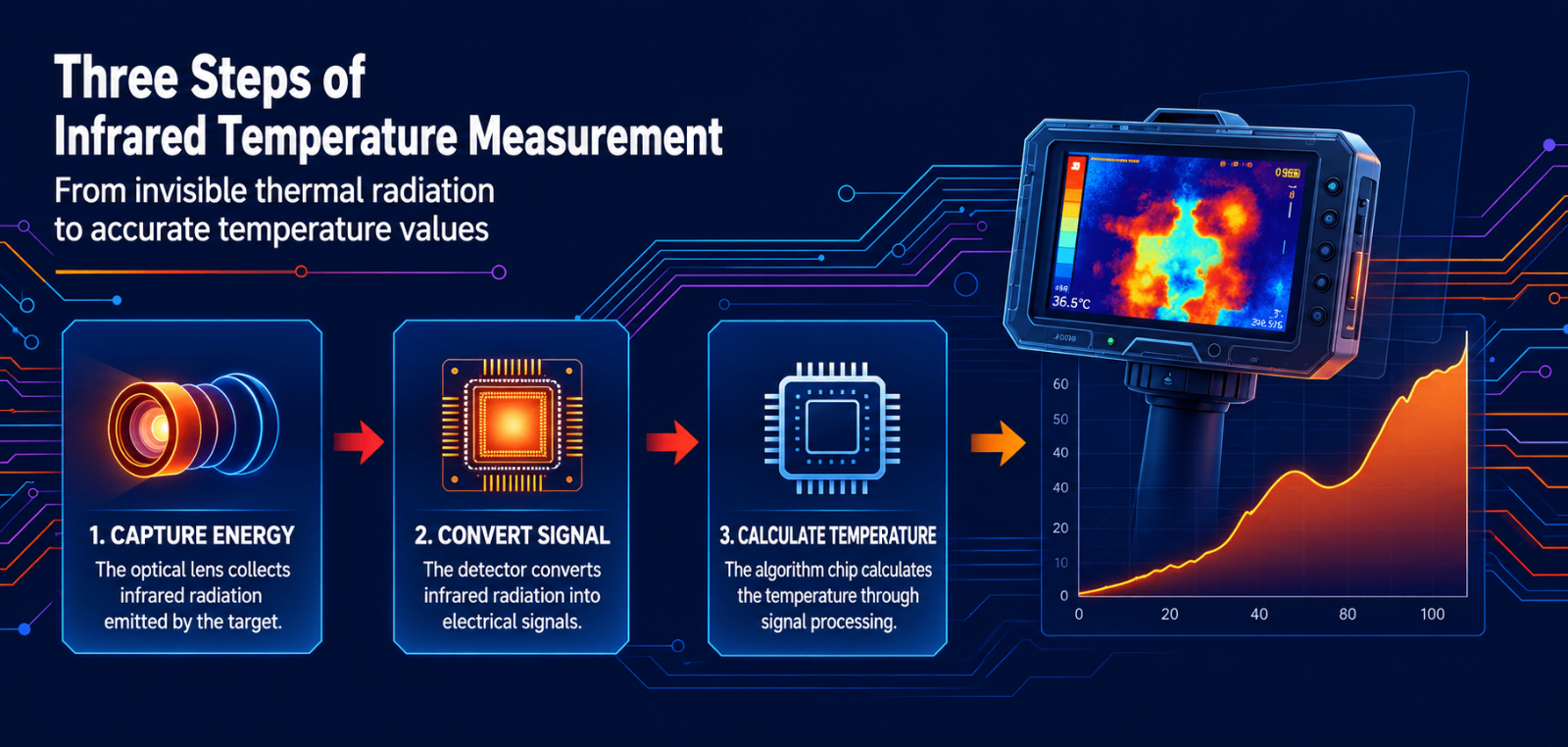
Infrared temperature measurement has already become an integral part of both daily life and industrial applications, from household forehead thermometers to thermal imaging cameras used in substation inspections. Without touching the target object, it can quickly determine its temperature. But have you ever wondered how non-contact temperature measurement actually works? Today, let's uncover the sensing principles behind infrared temperature sensors.
Part 01: The Fundamental Principle — Everything Emits an “Infrared Signal”
Infrared temperature measurement technology is based on Planck’s Law of Blackbody Radiation, which describes the relationship between an object's temperature and the infrared energy it radiates.
Any object with a temperature above absolute zero (-273.15°C) continuously emits infrared radiation that is invisible to the human eye. Thermopile sensors absorb this infrared thermal radiation and convert it into digital output signals.
In simple terms, the essence of infrared temperature measurement is to detect the infrared “light signals” emitted by an object and accurately translate them into temperature values.
Higher temperature → Stronger radiation energy → Shorter peak wavelength
Part 02: Breaking Down the Three Steps of Temperature Measurement
The process of infrared temperature measurement is essentially a precise relay race that translates “invisible heat” into “visible numerical data.”
Step 1: The Optical Lens “Captures” Energy
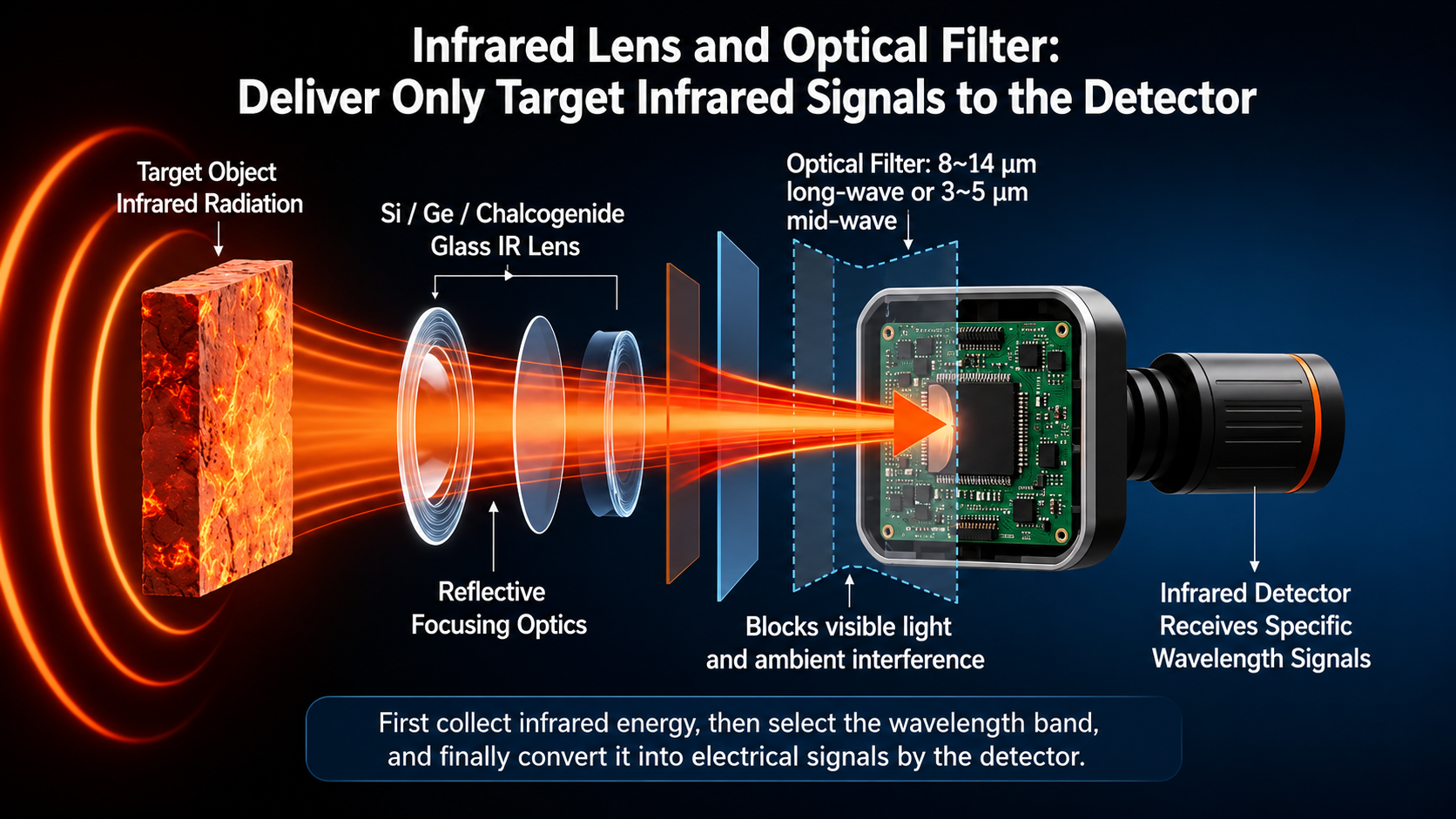
An infrared lens (commonly made of silicon, germanium, or chalcogenide glass) or a reflective mirror collects and focuses the infrared radiation emitted by the target onto the detector.
Meanwhile, an optical filter allows only specific infrared wavelength bands to pass through—such as the 8–14 μm long-wave band or the 3–5 μm mid-wave band—while blocking visible light and ambient interference.
Step 2: The Detector Performs the “Photoelectric Translation”
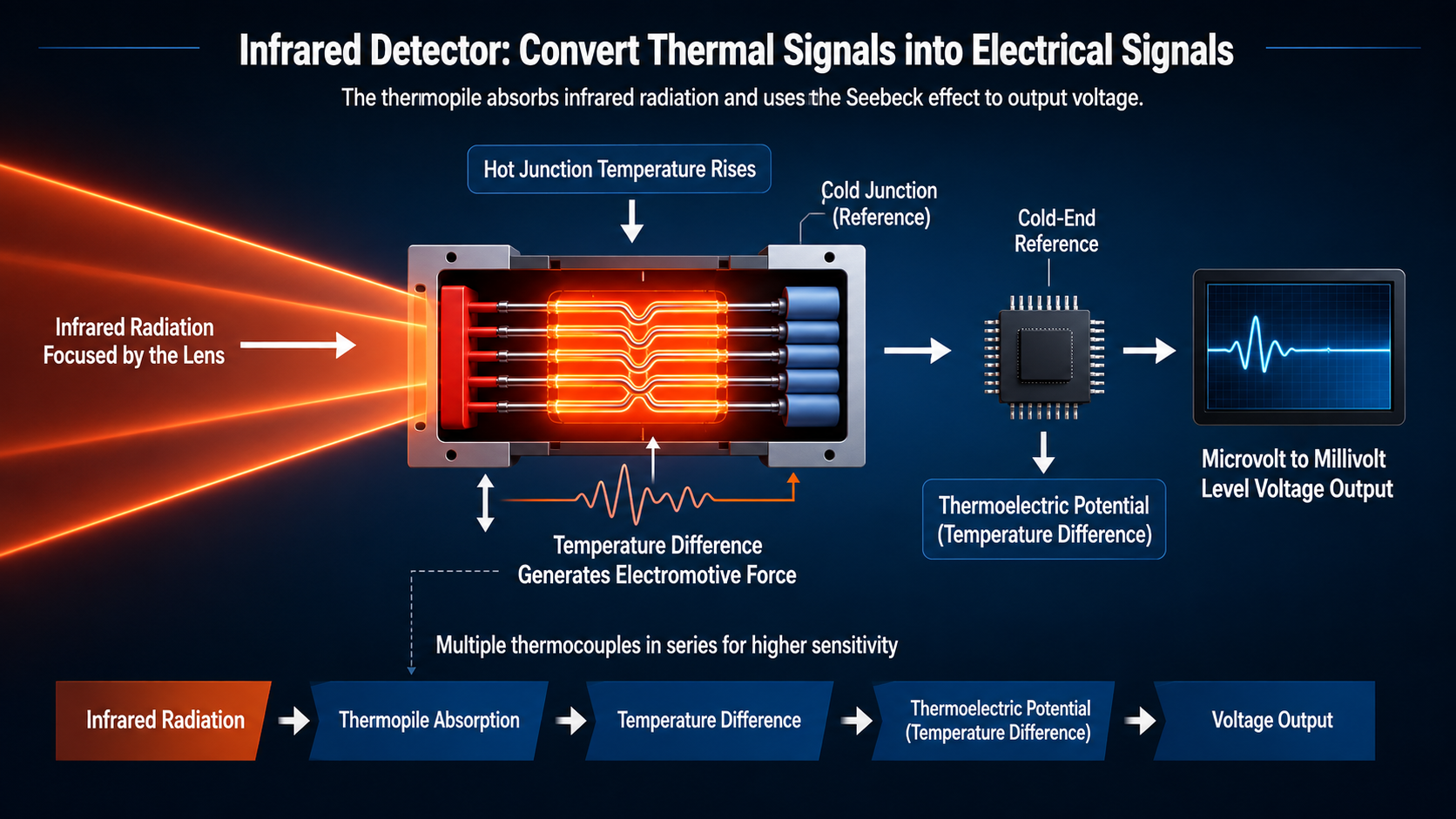
The focused infrared radiation strikes the infrared detector (Thermopile).
Today, thermopiles are the mainstream solution. They consist of multiple thermocouples connected in series. After absorbing infrared energy, the hot junction temperature rises relative to the cold junction, generating a thermoelectric voltage through the Seebeck Effect.
As a result, invisible thermal signals are successfully converted into measurable electrical signals in the microvolt-to-millivolt range.
Step 3: The Processing Chip Provides “Precision Calibration”
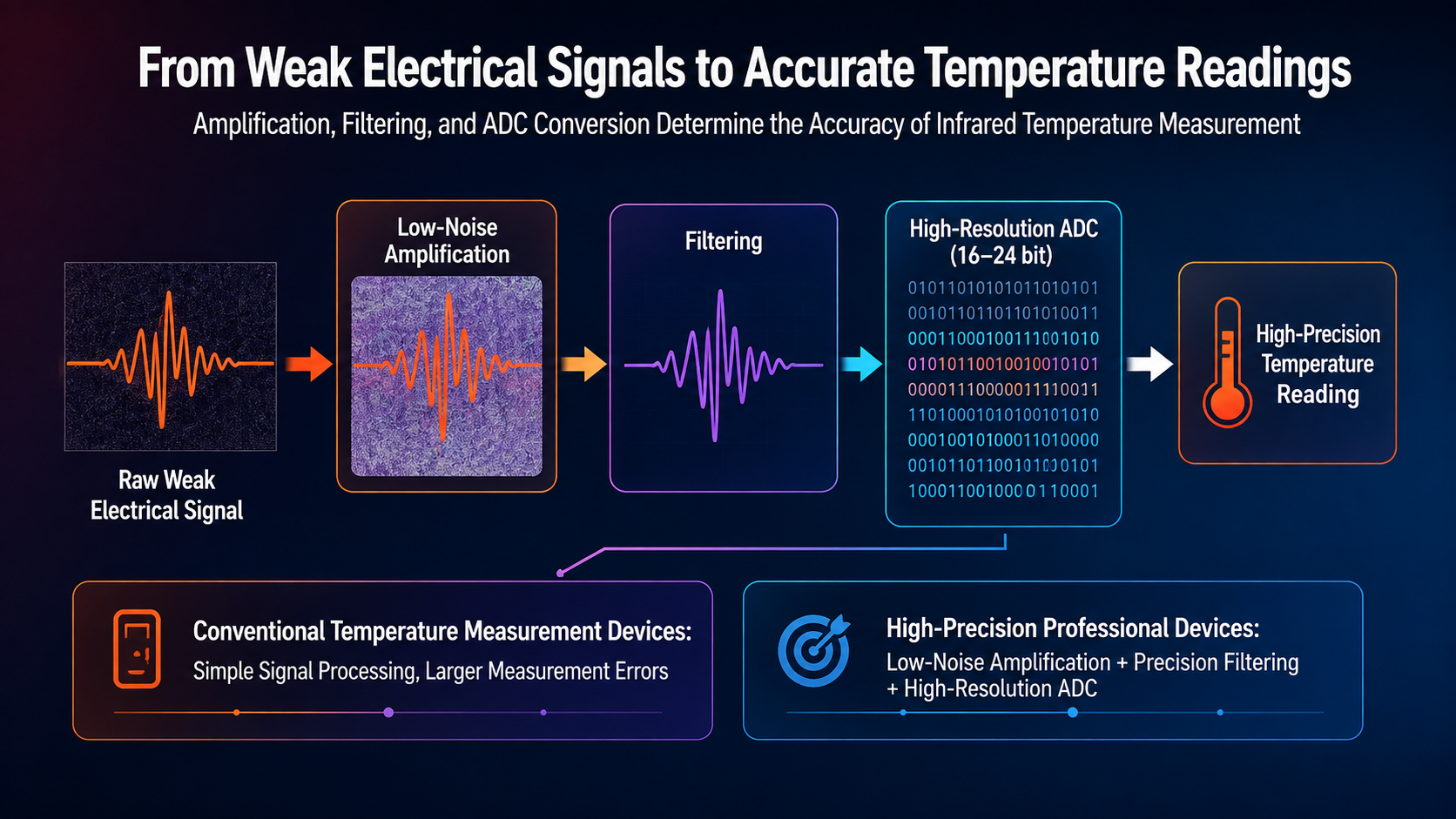
The raw electrical signal generated by the detector is extremely weak and contains significant noise. Therefore, it must undergo:
- Low-noise amplification
- Signal filtering
- High-precision ADC conversion (16–24 bit)
to be transformed into usable digital data.
This stage is critical to the accuracy of infrared temperature measurement and often represents the key difference between ordinary temperature-measurement devices and professional high-precision instruments.
In summary:
- The optical lens is responsible for capturing thermal radiation.
- The detector is responsible for converting signals.
- The processing algorithm is responsible for calculating accurate temperatures.
Together, these three steps form a closed-loop system capable of delivering temperature measurements within milliseconds.
Part 03: Why Can It Measure Temperature Without Contact?
Once you understand the principle, non-contact temperature measurement is no longer mysterious.
Infrared thermometry does not literally “measure temperature through the air.” Instead, it detects thermal radiation emitted by the object from a distance.
Traditional contact-based temperature measurement methods, such as mercury thermometers and thermocouples, rely on heat conduction. The sensor must reach thermal equilibrium with the target, which requires physical contact and often results in slower response times and contamination risks.
Infrared temperature measurement, however, detects electromagnetic radiation naturally emitted by the object—much like our eyes detect visible light. Since no physical contact is required, infrared thermometry offers three inherent advantages:
Fast: Millisecond-level response times make it ideal for high-traffic screening and inspection applications.
Remote: Temperature measurements can be performed from several meters—or even tens of meters—away, helping to avoid cross-contamination.
Wide Range: From microsecond pulsed lasers to molten metal in blast furnaces, infrared temperature measurement can cover an extremely broad temperature range.
Part 04: Conclusion — Invisible Infrared, Visible Science
No contact is required—just an instant measurement. Infrared thermometry demonstrates in the most intuitive way that everything emits radiation, and science has learned how to “listen” to that heat. This invisible infrared light not only bridges the gap between physical theory and practical applications, but also embodies the true meaning of technology serving people through every precise measurement.