


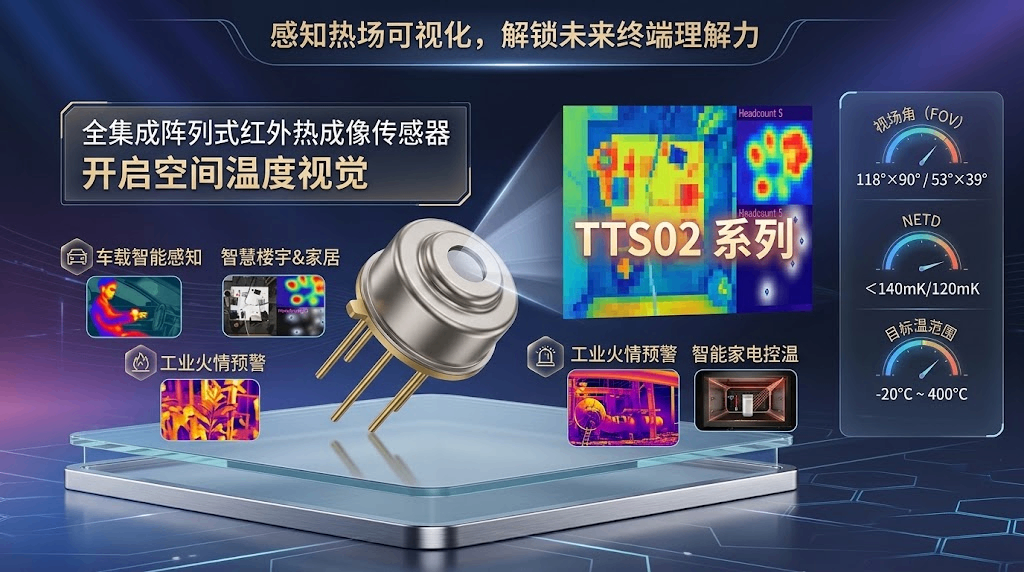
Introduction: Enabling Devices to Perceive the Invisible World of Thermal Radiation
In the physical world, all objects above absolute zero continuously emit infrared radiation energy. From active temperature control in smart cockpits and precise temperature regulation for smart home appliances to safety early‑warning in industrial scenarios, end‑user devices are comprehensively advancing toward thermal‑field visualization and array‑based perception.
The TTS02 series 32×24 pixel thermopile infrared temperature measurement sensor (TTS02-0B2/TTS02-0D5) integrates 768 micro-thermopile pixels and a high performance processing chip within a compact metal housing. It allows devices to reconstruct realtime spatial temperature distribution and achieve non-contact temperature measurement.
I. Core Architecture: What is TTS02?
TTS02 is a fully integrated, digital output array type infrared thermal imaging sensor. Based on the Seebeck effect, each micro pixel sensitively captures infrared radiant energy from target objects and converts it into temperature rise electrical signals.
On chip integrated algorithms: Built-in analog front end, 16 bit ADC and digital processing unit.
Direct absolute temperature output: On chip OTP parameters are automatically invoked for real‑time calibration and compensation. Calibrated temperature values are written directly to on‑chip RAM. The host MCU can read data via the I2C interface, significantly saving system computing resources.
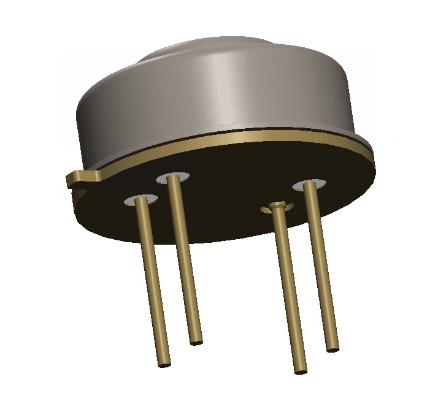
II. Dualmodel Portfolio: Precisely Matching Different Fieldsof View
Two optical configurations are available for TTS02 to satisfy diverse detection-distance and field of view requirements.
|
Parameter |
TTS02‑0B2 |
TTS02‑0D5 |
|
Field‑of‑View (FOV) |
118°×90° |
53°×39° |
|
Noise Equivalent Temperature Difference (NETD) |
<140 mK @ 1 Hz |
120 mK @ 1 Hz |
|
Package |
TO39 4‑pin |
TO39 4‑pin |
|
Applicable Scenarios |
Large‑space coverage, presence detection |
Hot‑spot monitoring for small fixed areas |
III. Key Performance and Specifications
- Wide temperature: measurement range: Target object temperature: -20 ℃ ~ 400 ℃; Operating ambient temperature: -40 ℃ ~ 85 ℃ (builtin reference temperature sensor with ±0.5 ℃ accuracy).
- Ultra-fast response and configurable frame rate: Thermal response time of only 20 ms; refresh rate adjustable from 0.5 Hz to 64 Hz (halfframe).
- Ultra-low power consumption: Typical operating current 10 mA; sleepmode current only 10 µA, suitable for low power and battery powered devices.
- Highspeed communication and high reliability: Standard I2C interface (up to 900 kHz); hermetically sealed 4 pin TO39 package; HBM ESD tolerance up to 2000 V; RoHS compliant.
IV. Diverse Realworld Application Scenarios, Unlocking New Potential for Thermal Perception
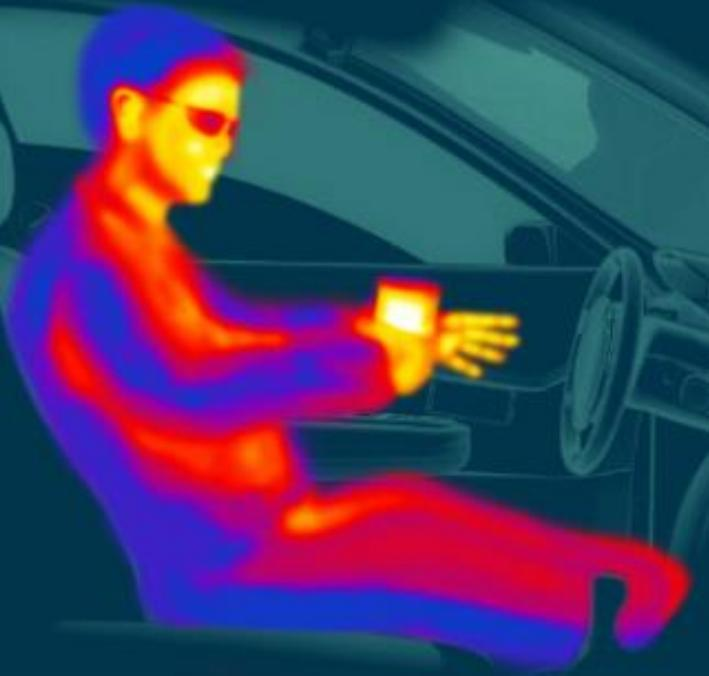
🚗 Automotive Electronics | Smart Cabin Perception
Comfort air conditioning temperature control in vehicle cabins; rear seat infant/pet left behind detection. Thermal signatures of living bodies can be identified even in total darkness without visible light dependency, safeguarding driving safety and optimizing logic for zoned air conditioning control.
🏢 Smart Buildings & Smart Home
Indoor human presence detection, spatial thermal distribution monitoring, linkage with smart air conditioners and floor heating. The wide FOV variant can cover an entire room, detecting human presence and activity status to trigger power on upon occupancy and power off upon vacancy, enabling energy saving for buildings.

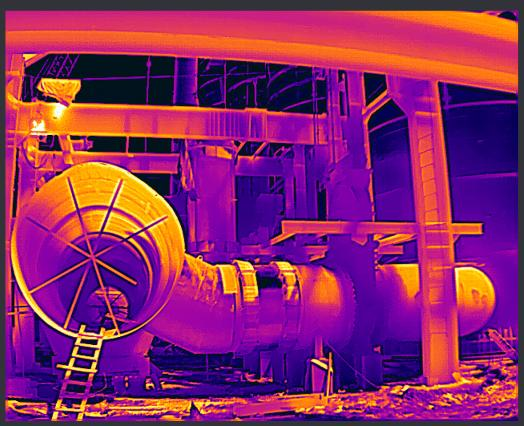
🔥 Fire Safety & Industrial Monitoring
Hot spot inspection of equipment, early stage fire risk warning, non-contact temperature inspection for industrial machinery. It captures local abnormal high temperature points to detect potential faults in advance. Its wide target temperature range of -20 ℃ to 400 ℃ fits most industrial equipment monitoring use cases.
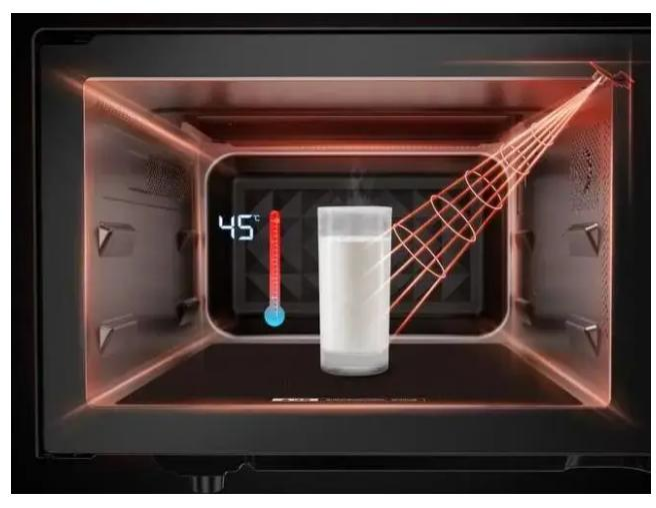
🍳 Consumer Appliances, Microwave Ovens, Smart Cooking
Multi‑point temperature monitoring inside oven cavities. It perceives thermal distribution within the cavity without physical contact with food ingredients, optimizing heating strategies and raising the intelligence level of home appliances.
🛠️ Other Extended Applications
Non contact multi-point temperature measurement, equipment overheat protection, auxiliary thermal detection for security surveillance, etc. Standardized hardware interfaces enable fast integration into a broad range of products.
V. Hardware Integration Tips to Shorten Development Cycles
- Hardware circuit: Standard I2C interface; connect 1 kΩ pullup resistors for SDA / SCL. Fit 10 µF + 100 nF filter capacitors on the power supply rail to stabilize power input.
- Critical PCB installation requirements: Maintain ≥2 mm clearance between the TO base and the PCB, or implement an isolating cutout on the PCB to mitigate coldjunction temperature drift induced by heat from adjacent components and guarantee temperature measurement accuracy.
- Operating modes: Idle standby mode on poweron; Normal mode for regular temperature acquisition; Sleep mode with power consumption reduced to 10 µA for low power products.
- Communication notes: Insert an interval longer than 3 LS_CLK cycles between I2C writeto read transitions to prevent communication errors. 16 bit register addresses are transmitted high byte first, followed by low
VI. Why Choose TTS02?
✔ Dual field of view options: Wide angle and medium FOV hardware variants for large area coverage and focused fixed point monitoring respectively
✔ High level on chip integration: Built in complete calibration algorithms; MCU reads temperature outputs directly without heavy external computation
✔ Mature TO 39 package: Minimalist 4 pin footprint, strong resistance to environmental interference and high mass production reliability
✔ Balanced performance and power efficiency: Industrial grade wide operating temperature range; micro ampere level sleep current compatible with battery operated hardware
✔ Domestic developed solution with stable component supply, supporting cost reduction and performance upgrade of hardware products.
📮 Technical Support: Datasheets and technical consultation are available. Hardware engineers and solution providers are welcome to inquire about component selection and sample testing.